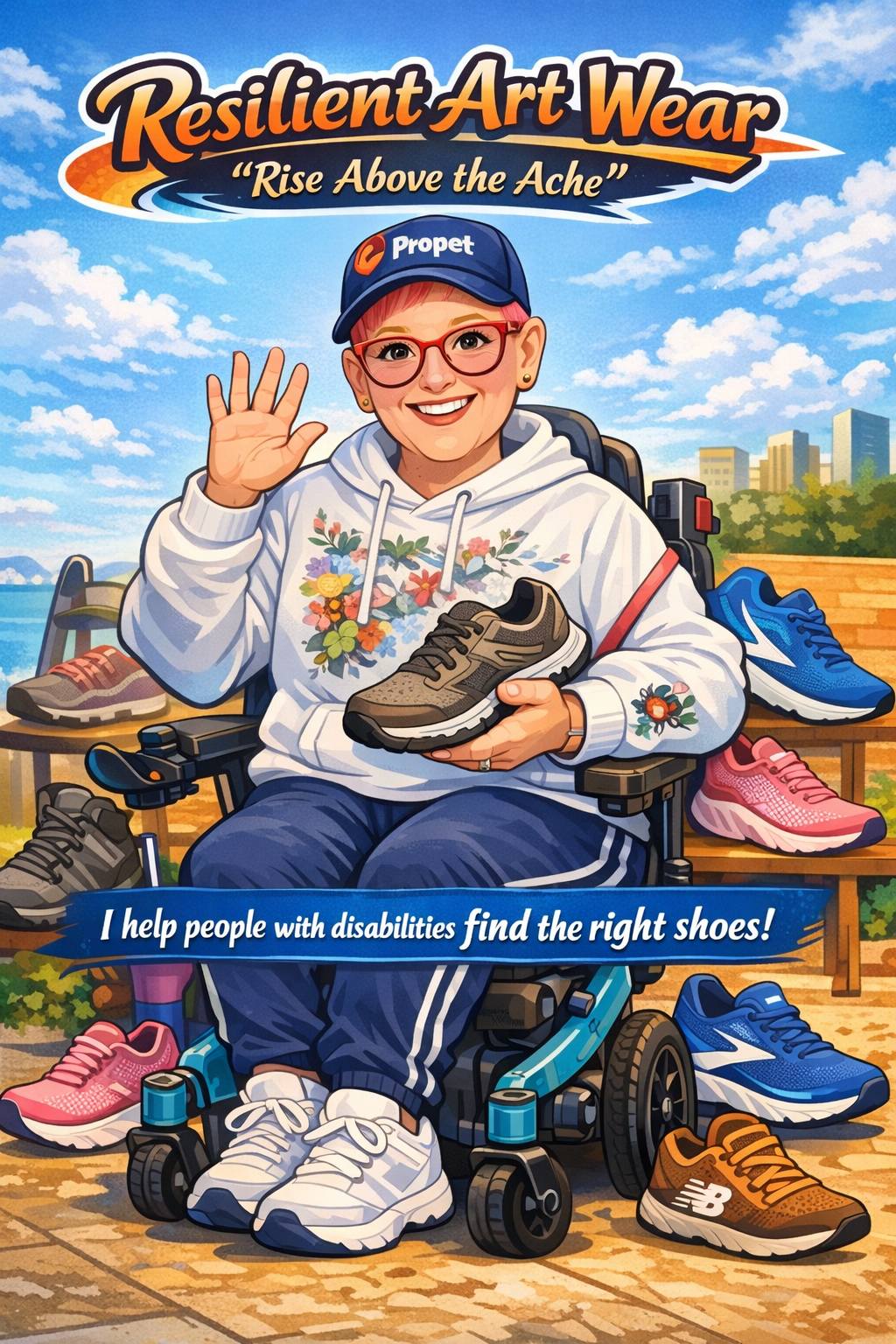
“My name is Tammy Eddy, and at 58, my life changed in ways I never expected. Living in California with my husband, I battle severe Neuropathy, Spondyloarthritis, and Radiculopathy. These aren’t just medical terms to me; they are the reasons I’ve had to use a wheelchair and why I face the constant risk of falling every single day.
Because of the neuropathy, my muscles have weakened to the point where I can only stand for a few minutes before my legs give out. I don’t need shoes for the gym or for running marathons. I need shoes that serve as my foundation—light enough to lift, stable enough to keep me grounded, and wide enough to give me those extra seconds to catch myself if I stumble.”
Why the Phoenix?
Resilient Art Wear Phoenix
“You’ll see our Phoenix logo throughout this site. It represents more than just a brand; it is my personal symbol of resilience. Like a Phoenix rising from the ashes, I’ve had to reinvent how I move and live. Every time I find a way to take a few more steps or discover a product that makes life easier, I am rising. I want this site to help you find that same fire within yourself to Rise Above the Ache™.”
A Solution for Every Step
“What works for me doesn’t work for everyone, and I see that every day in my own family.
• For Me: I need flat, ‘fanned out’ soles for maximum stability. I cannot wear rocker soles—they make me feel like I’m on a balance beam.
• For My Daughter: My 42-year-old daughter faces the challenges of obesity and being knocked-kneed. Her body needs the exact opposite of mine—she finds relief in soft, cushioned rocker bottoms that help propel her forward and protect her joints.
We aren’t just selling shoes; we are sharing the ‘living lab’ of our own lives. We’ve tested the Hoka, the Brooks, the Orthofeet, and the budget-friendly alternatives to find what actually works for different bodies and different pains.”
Our Invitation to You
“Whether you are fighting neuropathy like me, or looking for joint relief like my daughter, we are here to help you skip the guesswork. Thank you for being part of our journey. Let’s walk this path together.”
When you live with neuropathy, muscle atrophy, or spondyloarthritis, every step can feel like a gamble. The “ache” isn’t just physical pain; it’s the mental weight of wondering if your next step will lead to a fall. To regain your independence, you need more than just a shoe—you need a Stability Anchor.
What is a Stability Anchor?
Stability Anchor Shoe
A stability anchor is footwear specifically designed to ground you when your body feels unsteady. For those of us rising from the “ashes” of a disability, these anchors provide three critical lifelines:
• Wide Base of Support: A wider outsole creates a larger “footprint,” which helps distribute your weight evenly and prevents the side-to-side wobbling that leads to trips.
• Maximum Shock Absorption: Deep, high-quality foam (often 40mm or more) acts as a buffer between your sensitive nerves and the hard ground, significantly calming nerve pain.
• Guided Gait: Many anchors feature a curved sole design that gently rocks your foot forward, reducing the energy needed to walk and protecting your lower back and joints.
Safety and Independence
For the mobility-challenged community, the right anchor can be a game-changer for balance and safety. Features like hands-free entry allow you to step into your day without the struggle of bending over, which is a major win for those with limited range of motion or vertigo.
Living with a disability doesn’t mean you have to stay grounded. By choosing a shoe that acts as a true anchor, you can protect yourself from frequent falls and find the strength to Rise Above the Ache™.
Would you like me to help you create a “Stability Checklist” image to go with this article so your readers know exactly what features to look for when they shop?
When you’re living with chronic pain, “just going for a walk” can feel like a mountain to climb. That’s why I’m always on the lookout for what I call Stability Anchors—shoes that don’t just look good, but actually help us rise above the ache.
Tammy’s Transparency Note: This post contains affiliate links. As an Amazon Associate, I earn from qualifying purchases at no extra cost to you. I only recommend what I truly believe helps us move better!
Why the Experts Love It
You don’t just have to take my word for it. Board-certified podiatrists like Dr. Anne Sharkey and Dr. Priya Parthasarathy recommend the 1080 v14 for its incredible ability to handle everything from plantar fasciitis to osteoarthritis in our hips and knees. It’s even earned the APMA Seal of Acceptance, which is basically the “gold star” of foot health.
The ‘Real’ Benefits for You
• Cloud-Like Cushioning: The Fresh Foam X midsole is designed to absorb the “shock” of every step. This is a lifesaver if you’re managing joint pain in your ankles, knees, or even your back.
• The Gentle Rocker: See that slight curve in the sole? That’s “Rocker Geometry.” It helps your foot roll forward naturally, taking the strain off your Achilles and the balls of your feet.
• Room to Breathe: The engineered mesh upper is soft and accommodating. If you deal with bunions or just need a wider toe box so your toes can splay naturally, this shoe has your back.
• Heel Lockdown: They’ve redesigned the heel counter to cradle your foot without irritating your Achilles. This makes it a great partner if you wear custom orthotics.
This shoe is a fantastic option for walkers who need maximum plushness and a “premium” feel. Because of the high cushioning and rocker design, it’s also a great choice for those of us carrying a bit of extra weight who need that extra support.
⚠️ A Quick Warning: Because this is a neutral shoe with very high, soft cushioning, I do not recommend it if you struggle with severe balance issues, neuropathy, or specific types of chronic back pain. In those cases, we want something with a bit more “ground feel” and side-to-side stability.
The NORTIV 8 Women’s Hands Free Slip On is a high-performance alternative for those looking to “Rise Above the Ache” without the high price tag. While premium brands can cost double or triple, this sneaker provides the essential stability and cushion needed for daily mobility.
• Hands-Free Ease: Slide in and out effortlessly without bending over, a major safety win for those with balance or pain issues.
• Cloud-Like Cushion:
Features a thick EVA midsole that absorbs shock and reduces joint impact, similar to much more expensive recovery shoes.
• Safety & Grip:
The slip-resistant rubber outsole ensures you stay grounded on smooth indoor surfaces or outdoor paths.
For Even More Value:
If you don’t need the hands-free heel but want the same breathable comfort, the NORTIV8 is often available for an even lower price while still offering 3M reflective safety and a deep heel cup for extra stability.
NORTIV 8 Men’s Comfortable Walking Shoes MovePropel Athletic Breathable Gym Workout Tennis Jogging Cross Training Non Slip Fashion Running Sneakers
Step into Comfort: The Power of Supportive Footwear
Comfort Shoes
Modern studies show that the right footwear can transform daily mobility and significantly ease chronic pain. Many individuals are discovering that well-designed shoes not only cushion each step but also promote proper alignment, reducing undue stress on joints and muscles. In urban areas and local communities alike, the demand for supportive footwear has surged as more people seek solutions to chronic discomfort without compromising on style.
Proper shoes offer several benefits:
Enhanced Stability: Shock-absorbing materials reduce the strain on knees and hips.Improved Alignment:Ergonomically designed soles support natural posture, aiding in pain relief.Increased Mobility: Secure, cushioned footwear encourages a more confident, active lifestyle.
This introductory guide will explore how quality materials and innovative design features work together to relieve long-term discomfort. You’ll learn actionable tips for choosing footwear that can lead to a more comfortable, energetic life, whether you’re navigating busy city streets or enjoying a stroll in your local park. Embracing the right footwear isn’t just about fashion—it’s about reclaiming your movement and comfort every day.
Choose Wisely: Avoid the Hidden Pitfalls of Poor Footwear
Sore foot from wearing the wrong shoes
Too often, everyday shoe choices contribute to chronic pain and reduced mobility. Footwear lacking proper support and cushioning can place unnecessary strain on joints and muscles, worsening discomfort over time. When shoes are too tight, overly worn, or lack customization for your foot type, they force your body into unnatural movements that exacerbate issues like plantar fasciitis, knee pain, and lower back strain.
Understanding the effects of poor footwear choices is essential for improving everyday mobility. Consider these practical tips:
Inspect your shoes regularly: Look for signs of excessive wear, flattened cushioning, or uneven soles.Prioritize proper fit: Ensure there’s adequate space in the toe box and arch support that complements your natural gait.Replace worn footwear: Consistent use of supportive shoes is crucial, so updating your footwear as soon as they lose their form helps maintain comfort and stability.
In areas with extensive pedestrian traffic and local communities, choosing shoes that provide ergonomic support not only improves individual well-being but also enhances overall mobility. Integrating these habits into your daily routine can drastically reduce chronic discomfort and support a more active lifestyle.
Top 7 Support Features for Chronic Pain Relief Footwear
Supportive footwear
When choosing footwear that eases chronic pain, it’s important to know what features deliver both comfort and support. Here are seven essential qualities to look for:
Optimal Arch Support Quality arch support promotes proper alignment and reduces stress on the foot. This feature is vital for individuals dealing with chronic discomfort and helps enhance stability.Superior Cushioning Effective cushioning minimizes impact during movement. It absorbs shock and alleviates pressure on sensitive areas, making it ideal for long days on your feet.Customizable Adjustability An adjustable fit—whether through laces, straps, or other closure systems—ensures a personalized feel. This adaptability is key to accommodating changes and providing consistent support.Breathable Materials Ventilation is crucial for comfort. Breathable fabrics help maintain a cool, dry environment which can prevent irritation during extended wear.Slip-Resistant Outsoles A secure grip on various surfaces minimizes the risk of slips and falls, offering added safety in local urban or rural areas.Lightweight Construction Lighter footwear reduces fatigue and strain, making movement easier and more pain-free.Ample Toe Room A spacious toe box discourages pinching and allows natural toe movement, contributing to overall foot health and comfort.
Empowering Mobility through Supportive Footwear
Choosing the right footwear can be a transformative step for anyone managing chronic pain, especially those with mobility challenges. Supportive shoes offer more than just comfort; they play an essential role in enhancing balance, reducing strain on joints, and promoting proper alignment. By incorporating features like cushioned insoles, arch support, and shock-absorbing soles, these shoes address the unique needs of individuals with disabilities, helping them move more freely and confidently.
Key benefits of supportive footwear include:
Enhanced Stability: Reduced risk of slips or falls due to improved grip and structural design.Pain Relief: Alleviating pressure on sensitive areas, which can lead to decreased discomfort.Improved Posture: Encouraging correct foot alignment that benefits overall body posture.
Local communities benefit when footwear is designed to meet their specific needs, allowing individuals to enjoy community events, work, and daily activities with greater ease. Adopting a thoughtful approach towards footwear choice is a practical, actionable step in managing chronic pain while promoting a more active, independent lifestyle.
Frequently Asked Questions
FAQ
How does supportive footwear ease chronic pain? Properly designed shoes offer cushioning, enhanced arch support, and a stable base to distribute pressure evenly. This minimizes the impact on joints and muscles, reducing overall discomfort during daily activities.
What key features should I look for in shoes for chronic pain relief? Focus on footwear with shock absorption, ergonomic footbeds, slip-resistant soles, and adjustable closures. These features help improve alignment, promote comfort, and adapt to varying foot shapes and sizes.
Are there specific materials that benefit people with chronic pain? Yes, shoes constructed with breathable, lightweight fabrics and high-quality foam or gel insoles enhance comfort. Additionally, materials that mold to the foot’s contours help minimize pressure points.
Why is the proper fit so crucial for pain management? An accurate fit prevents excessive friction and abnormal pressure distribution. Shoes that are too tight or too loose can worsen pain and lead to secondary issues.
How can local customers confidently choose the right footwear? Visit reputable local retailers for professional fittings, ask for personalized recommendations, and test the shoes thoroughly. Taking these steps ensures you find footwear that truly alleviates pain while enhancing mobility.
Final Steps for a Pain-Free Future
Pain Free Future
In wrapping up this guide, it’s clear that prioritizing supportive footwear is essential for effective chronic pain relief. The journey toward improved comfort and enhanced mobility starts with selecting shoes that offer stability, cushioning, and proper arch support. These elements not only help stabilize your posture but also minimize the daily impact of chronic pain on your movements.
Consider these actionable steps:
Evaluate your current footwear for signs of wear and inadequate support.Choose shoes designed with durable, shock-absorbing materials.Seek professional advice to ensure a proper fit tailored to your specific needs.Gradually incorporate supportive footwear into your daily routine to allow your body to adapt.
For individuals in local communities, accessing quality options close to home can make a significant difference in managing discomfort. By being proactive and making informed decisions about your footwear, you empower yourself to reduce pain and enhance overall quality of life. Remember, every step you take toward better support is a step toward a healthier, more resilient future.
Walking after a stroke or while managing Neuropathy often feels like learning a completely different language. Your balance might feel uncertain, your muscles may tire quickly, and that “smooth” step you used to have might feel heavy or disconnected.
At Resilient Art Wear, we believe that movement is a form of art, and every step is a victory. My mission is to help you Rise Above the Ache by finding your Resilient Anchor—the footwear that gives you the stability to reclaim your independence.
Choosing the right shoe isn’t just about fashion; it’s about safety, confidence, and the freedom to stay active during your recovery. Let’s dive into how the right anchor can transform your walk.
Walking After a Stroke – Understanding the Change
For many survivors, walking involves relearning movements that once felt automatic. You might be navigating foot drop, difficulty clearing your toes, or a general sense of instability on uneven surfaces.
When sensation is reduced or muscle stiffness sets in, it’s hard to judge exactly where your foot lands. This is where your footwear needs to step in as your partner. A proper “Stable Anchor” doesn’t just cushion your foot; it steadies your gait and reduces the mental energy required just to take a step.
How the Right Footwear Helps You Rise Above the Ache
While footwear doesn’t replace physical therapy, it reinforces your progress. A well-chosen shoe acts as a tool to:
• Improve Groundedness: Giving you a secure feeling as you shift your weight.
• Lighten the Load: Reducing the effort needed to lift your foot, which is vital if you suffer from fatigue or weakness.
• Support the Alignment: Keeping your ankle from rolling unexpectedly.
• Enhance Traction: Providing the grip you need to feel safe on slick kitchen floors or outdoor paths.
• Accommodate AFOs: Offering the depth and structure required for ankle-foot orthoses to fit comfortably.
What to Look For in Your Resilient Anchor
1. A Wide, Stable Base: Prevents wobbling and provides a “planted” feel.
2. Firm Heel Counter: Holds your heel in place to prevent the ankle from collapsing inward or outward.
3. Lightweight Design: Every ounce matters when you are battling muscle fatigue.
4. Adaptive Closures: Look for Velcro, zippers, or elastic laces if fine motor skills make traditional laces a struggle.
5. MetaRocker Geometry: A curved sole that helps “roll” your foot forward when your muscles need an extra boost.
My Top Recommendation: The Brooks Ghost Max 3
One of the best “anchors” I have found for stroke recovery and neuropathy is the Brooks Ghost Max 3. It features a broad base for incredible stability and a rocker shape that helps you move from landing to toe-off with less effort.
This shoe is designed to provide maximum protection and comfort, allowing you to focus on your recovery and less on the ache.
Tammy’s Tip: When you’re recovering, remember that progress isn’t a straight line—it’s a journey. Choosing the right gear is the first step in making that journey a little smoother. Stay resilient!
When you live with chronic pain or a disability, your relationship with the ground changes. Whether it’s the burning sensation of Neuropathy, the weakness from Muscle Atrophy, or the constant stiffness of Spondyloarthritis, every step can feel like a gamble.
I’m Tammy, and I’ve been there. I know what it’s like to feel the “ache” and the fear of falling. That is why I created Resilient Art Wear (RAW)™. I wanted to find the “Safety First” tools that help us reclaim our independence.
In this community, we don’t just buy shoes; we find Stability Anchors.
What is a Stability Anchor?
A Stability Anchor is more than just footwear. It is a foundation designed to keep you grounded, balanced, and moving forward. For us, a shoe must do three things:
1. Protect: Absorb the impact that usually flares up our sciatica or back pain.
2. Support: Keep our ankles and heels from “wobbling.”
3. Empower: Make it easier to step in and get out, especially when our hands or backs don’t want to cooperate.
Matching Your Condition to the Right Anchor
For Neuropathy & Nerve Pain: The “Cloud Buffer”
If you feel like you are walking on glass or hot coals, you need maximum cushioning.
• Why it works: The thick “marshmallow” sole acts as a buffer between your sensitive nerves and the hard pavement. It’s like a “bucket seat” for your feet.
For Muscle Atrophy & Weakness: The “GuideRail”
When your muscles are tired, your feet tend to roll or drag. You need a shoe that corrects your path.
You’ll see the Phoenix on my logo because it represents us. We might have had to “burn down” the life we once knew due to our disabilities, but we are rising from the ashes every single day.
Every step you take in a Stability Anchor is a victory.
Let’s keep the support chain going. Which “ache” are you trying to rise above today?
Resilient Art Wear (RAW)™, we believe that to Rise Above the Ache™, you need a foundation that respects how your body was meant to move. Like the Phoenix rising, these shoes represent a fresh start for your feet—reclaiming the strength and alignment that traditional, narrow shoes often take away.
Hike Footwear is worth taking a look at, but not for everyone.
Hike Barefoot Womens Anti Slip Barefoot Vitality Shoes Comfortable Zero Drop Swim Athletic Hiking Grounded Footwear Minimalist Zero Drop Wide Toe Box Footwear Unisex
• Rise Above the Pressure: Our orthopedist-approved design focuses on total pressure relief for feet and joints, specifically targeting the discomfort of neuropathy and arthritis.
• The Wide Toe Box Advantage:
By allowing your toes to spread naturally, these shoes provide a wider base of support, which is essential for “Safety First” balance and preventing falls.
• Enhanced Sensory Feedback:
The thin, flexible sole lets your brain “feel” the ground again. This improved sensory feedback is a game-changer for those of us navigating stroke recovery or muscle atrophy.
• Real Stability & Traction:
Step confidently with slip-resistant traction that ensures steady support on any terrain, whether you are indoors or out.
• Breathable Relief:
Crafted from airy, lightweight fabrics, these shoes keep your feet cool and dry, providing essential relief for sensitive nerves.
Unlock Your Body’s Potential
Our grounded footwear strengthens the muscles in your feet and legs, promoting a natural stride that alleviates pain in your knees, hips, and back. It isn’t just a shoe; it’s a Stability Anchor designed to help you reclaim your energy and vitality.
The Arch Support You Deserve
Ergonomically designed to align your entire body, Hike Footwear helps discomfort fade from toes to heels. When your feet are aligned, you walk taller and move with the “Real About Walking” confidence that defines our community.
• Hike shoes are make to give the bare foot feel, so for those of you that love your flip-flops, these might be your perfect stable anchor.
When you are living with a progressive neurological disorder like Parkinson’s Disease, the simplest tasks—like putting on shoes—can become a daily battle. Tremors, muscle rigidity, and slowed movement make bending over and tying laces not just difficult, but a safety risk.
At Resilient Art Wear (RAW)™, my mission is to help you “Rise Above the Ache™”. Today, I am introducing a Stability Anchor that changes the game for independence: Kizik Hands-Free Shoes.
Why Hands-Free is a “Safety First” Priority
For the more than 10 million people worldwide living with Parkinson’s, gait changes and balance challenges are a constant reality.
• Stop the Struggle: Kizik’s patented External Flex Arc allows you to step directly into the shoe without bending over or using your hands.
• Maintain Your Balance: By eliminating the need to lean over or sit in awkward positions to fix your shoes, you stay upright and steady.
• Support for Neurological Conditions: While not a medical treatment, many users with Multiple Sclerosis, Parkinson’s, and Reduced Grip Strength find that these shoes restore a sense of ease to their morning routine.
The Monaco: Retro Style Meets Modern Stability
The Kizik Monaco isn’t just easy to put on; it’s built to keep you grounded once you’re moving.
• Stable Traction: The full rubber outsole delivers the grip you need to prevent slips and slides, especially if you deal with “freezing” or shuffling steps.
• Cushioned Comfort: A high-rebound foam midsole absorbs the impact that can flare up joint pain, while the padded Comfort Collar secures your heel so the shoe won’t “flop” or cause a trip.
• Premium Materials: A blend of textile and suede overlays means these are durable enough for daily wear and look like a classic, stylish sneaker—not a “medical” shoe.
Shop the Monaco Collection
Ready to reclaim your morning? Find your perfect fit and Rise Above the Ache™ with these RAW-verified links:
Perfect for: Limited mobility and balance issues. Effortless entry meets a timeless sneaker look.
Like the Phoenix, We Keep Moving
Parkinson’s symptoms may begin subtly, but they don’t have to define your journey. By choosing a shoe that respects your mobility and protects your balance, you are choosing to stay resilient.
Are you ready to try the hands-free revolution? Tell me in the comments how “Step-In” technology has helped you stay independent!
Hi, I’m Tammy. I’m 58 years old, and I live in the beautiful, sunny landscape of Menifee, California. If you stepped into my home, you’d likely find me surrounded by paint and craft supplies. Painting is my “go-to” for expression, but I’ve never met a craft I didn’t want to try.
Beyond my art, I am a wife, a mother to two adult children, and a proud grandmother to two grandsons. They are my world, and they are a big part of why I refuse to let my physical challenges have the final word.
The Reality of the “Ache”
For the last six years, I have navigated life from a wheelchair. My mobility is very limited, and I live with a list of conditions that often feel like they are competing for my attention:
• Neuropathy & Fibromyalgia: Constant nerve pain and sensitivity.
• Spondyloarthritis & Radiculopathy: Impacting my spine and nerve roots.
• Muscle Atrophy: Making it physically difficult to lift and move my limbs.
• Ménière’s Disease & Balance Issues: Creating a world that feels unsteady and making me a high fall risk.
I know what it’s like to face the “ashes” of the life you once knew. But I also know what it’s like to fight back. I’ve overhauled my health, started eating better, and I am officially Diabetes Free!
Finding My “Stable Anchor”
Because I am a fall risk, I became obsessed with researching shoes for chronic pain and balance. What I discovered is that not all shoes are created equal. Just as every disability is unique, every foot needs a specific kind of support.
For me, the Hoka Gaviota 5 was a turning point.
• Lightweight for Atrophy: They are incredibly light, making it easier for me to lift my feet despite muscle weakness.
• Roomy for Neuropathy: The softness and extra space cater to my sensitive nerves.
• The Anchor Effect: Most importantly, the wide sole width creates a stable base that has led to fewer falls and fewer terrifying trips to the Emergency Room.
I didn’t start Resilient Art Wear (RAW)™ just to talk about shoes. I started it to build a “support chain”. I want to use my experience—and my artist’s eye—to help you find the Stability Anchor that keeps you grounded while you reach for the stars.
We are like the Phoenix. We may have been burned by our conditions, but together, we have the strength to stand back up.
Hi everyone, Tammy here. If you’ve been following my journey at Resilient Art Wear, you know my mission is to help us all “Rise Above the Ache”. Living with severe neuropathy and muscle atrophy means my mobility is limited, and I am a high fall risk. After several scary trips to the ER, I learned firsthand that the right shoes aren’t just about fashion—they are a vital “Stability Anchor” for our safety.
Today, I want to talk about a brand that is making life much easier for those of us who struggle with balance, back pain, or the simple act of bending over: Skechers.
The Magic of Hands-Free Slip-ins®
For anyone recovering from a stroke, managing Parkinson’s, or dealing with obesity and chronic back pain, tying laces can feel like climbing a mountain. Skechers Hands Free Slip-ins® use an exclusive Heel Pillow™ technology that allows you to step right in without using your hands, holding your foot securely once you’re in.
Support You Can Trust: Arch Fit® and Glide-Step®
Skechers doesn’t just focus on convenience; they focus on podiatrist-certified health:
• Arch Fit® Technology: Developed with 20 years of data, this removable insole system provides supportive cushioning recognized by the American Podiatric Medical Association (APMA).
• Glide-Step® Midsole: This geometric design acts like a spring, offering a “pillow-like” landing and a smooth takeoff to help create natural momentum as you walk.
Tammy’s Top Picks for Stability and Comfort
Tammy’s Tip: I recommend purchasing through the Amazon links below and trying them on inside your house first. Don’t wear them outside until you’re sure! Amazon makes returns easy if the fit isn’t perfect.
• No Bending Required: Perfect for those of us with limited range of motion or back pain.
• Podiatrist Certified: Real science and 20 years of data behind the arch support.
• Pillow-Soft Landings: The geometric midsole helps absorb the impact that can be so painful for neuropathy.
• Secure Fit: The “Heel Pillow” keeps your foot from sliding, which is a huge “Stability Anchor” for fall risks.
The Cons:
• Fit Consistency: Some users find they need to size up or down to get that “Slip-in” seal just right.
• Casual Style: Most of these models are very sporty, so there are fewer options for formal occasions.
• Soft Soles: While they are incredibly comfortable, the very soft foam can wear down faster if you are walking on rough concrete every day.
🛡️ Tammy’s “Safety First” Tip
Before you head outside!
When your new Skechers arrive, I highly recommend trying them on inside your home first. Walk around on your carpet or rug to make sure the “Heel Pillow” feels secure and the arch support hits you in the right spot.
Why this matters:
• Zero Risk: Amazon makes returns incredibly easy and convenient if the shoes aren’t a perfect fit—but they usually require them to be in “like-new” condition.
• Protect Your Stability: If you have neuropathy or muscle atrophy like I do, you need to be 100% sure the shoe feels like a “Stability Anchor” before you trust it on uneven pavement or stairs.
Don’t commit to the shoes until your feet say “Yes!”
📌 WELCOME TO RESILIENT ANCHOR BLOG. (Affiliate of Resilient Art Wear RAW™)
Hi everyone! I’m Tammy, and I’m so glad you’re here.
If you’ve found your way to this page, chances are you or someone you love is navigating the “wobbles” of chronic pain or mobility challenges. I know that journey well because I live it every single day.
Who is Tammy?
I’m not just a business owner; I’m a survivor living with Neuropathy, Spondyloarthritis, and Radiculopathy. For a long time, my world felt like it was shrinking. But I decided to use my experience to help others Stop the Fall and Start the Rise™.
What is the “Living Lab”?
I don’t just “sell shoes.” I run a Living Lab.
Every shoe you see on my site has been vetted by me.
I look for Stability Anchors—footwear with wide bases, superior grip, and “Safety First” technology like hands-free entry.
If a shoe doesn’t provide the support needed to navigate chronic pain safely, it doesn’t make the cut.
Our Mission at ResilientArtWear.com
My website is a curated resource center designed to give you your independence back. Whether you need the medical-grade precision of OrthoFeet, the premium comfort of New Balance, or the effortless ease of Skechers Hands-Free Slip-ins, I’ve done the homework for you.
We are a community built on resilience. We aren’t just surviving; we are moving forward—one stable step at a time.
Thank you for being part of this journey. Let’s Rise Above the Ache™ together!
If you live with Neuropathy or Chronic Pain, you know that the “wobbles” are real. For a long time, my world felt like it was shrinking. Simple things—like bending over to tie a pair of sneakers—felt like climbing a mountain.
I’m Tammy, and I created the Living Lab at Resilient Art Wear because I was tired of footwear that didn’t understand the “Ache.” I decided to stop the fall and start the rise.
Testing the “Stability Anchors”
In my Lab, I don’t just look at shoes; I stress-test them for Independence. My latest discovery?
When I first tried these, I was skeptical. Could a shoe really stay secure without laces? Here is what I found:
• The “Heel Pillow” Magic: There is a unique cushion in the back that hugs your heel. It physically prevents that sliding feeling that causes trips.
• Zero Bending: You literally just step in. No shoehorn, no reaching down, no losing your balance
• The Comfort Factor: The Contour Foam feels like a soft hug for your feet, which is a lifesaver for sensitive nerves.
Independence is the Ultimate Goal
We often think of shoes as fashion, but for us, they are tools. Finding a shoe that lets you get ready in the morning without pain is a victory. It’s about taking that first stable step toward getting your life back.
Join the Rise
Whether you’re dealing with Radiculopathy or just tired of the struggle, you aren’t alone. We are a community of resilient souls moving forward, one “Stability Anchor” at a time.
Have you tried a hands-free shoe yet? Does it change your morning routine? Let’s talk about it in the comments below!
The footwear industry has long neglected those with disabilities and stability issues requiring a stable anchor for balance . Hoka is on a journey towards a future to enhance the quality of life of those that need it the most!
Hoka shoes are known for their maximalist cushioning, lightweight feel, and distinctive thick soles, designed to provide exceptional shock absorption, comfort, and support, making them popular with runners, athletes, and people with foot pain for activities from ultramarathons to daily walking. Founded in the French Alps, Hoka’s philosophy, inspired by the Māori word for “to fly,” focuses on making running feel easier and kinder to the body, incorporating features like rocker soles (MetaRocker) and stable bucket-seat midsoles for a smooth, propulsive ride.
Key Features:
Maximalist Cushioning:Thick, marshmallow-like midsoles absorb impact, reducing stress on joints.Lightweight Design: Despite the cushioning, Hoka manages to keep the shoes surprisingly light. Make the comfortable to people who suffer from Neuropathy, arthritis, joint pain, foot pain and ObesityMetaRocker Geometry: A curved sole design that helps propel your foot forward, promoting a natural gait.Stability: Features like the bucket seat and support systems (e.g., GuideRails in some models) offer stability without adding bulk.Versatility: Offers models for various needs, from ultra-cushioned (Bondi) to lightweight stability (Arahi) and racing shoes.
Who Wears Them:
People with Foot Issues:Beneficial for plantar fasciitis, arthritis, heel pain, or general foot fatigue.Everyday Wearers: Popular for walking, working, and general comfort due to their supportive nature.
Hi everyone, Tammy here! At Resilient Art Wear, we talk a lot about “Rising Above the Ache.” When you live with neuropathy, muscle atrophy, or mobility challenges, the “right” shoe is more than just an accessory—it is a Stability Anchor that keeps you safe and moving.
Today, I’m diving into Sorel sneakers. While many know Sorel for their winter boots, their sneakers are a secret weapon for those of us navigating chronic pain. They blend high-fashion artistry with serious technical support, proving you don’t have to sacrifice your style for your safety.
1. The Easy-On Essential: Sorel Women’s Kinetic™ Impact II Strap
• Best For: Parkinson’s, Multiple Sclerosis (MS), and Back Pain.
• Why it works: The hook-and-loop strap means no fumbling with laces if you have limited hand mobility. The LIVELYFOAM™ midsole provides incredible shock absorption, which is vital for Neuropathy and Fibromyalgia where every step can feel like a heavy impact.
• Stability: It features a wide, scalloped sole that acts as a steady base for those with Balance Issues or Spondyloarthritis.
• Best For: Muscle Atrophy, Obesity, and Osteoporosis.
• Why it works: The geometric design helps transition your weight smoothly from heel to toe. This “springy” feel makes walking feel less like a chore for tired muscles and helps protect sensitive joints from Knee Pain.
• Why it works: The breathable knit upper expands with your foot. If you deal with “burning” sensations or swelling from Neuropathy, this soft material won’t pinch or constrict you.
• Traction: The EVERTREAD™ rubber outsole provides a professional-grade grip to prevent slips, which is a “Safety First” essential for anyone with Balance Issues.
🛡️ Tammy’s “Safety First” Tip
As always, I recommend ordering through these links and trying the shoes on inside your home first. Walk on your carpets to test the stability and the feel before you wear them outdoors! This makes returns to Amazon easy and ensures you have found your perfect Stability Anchor.
Finding supportive, comfortable, and well-designed footwear shouldn’t require a premium price tag. As an advocate for the disabled community—and someone who meticulously tests shoes to help you Rise Above the Ache—I am always looking for options that offer excellent biomechanics at an accessible price point.
Recently, I spent four weeks testing the ALLSWIFIT line. This Amazon-exclusive brand has earned the APMA (American Podiatric Medical Association) Seal of Acceptance—a major credential recognizing shoes that actively promote foot health.
After a thorough evaluation, here is my clinician-tested, honest review.
⭐ The Verdict: What Stood Out
Across every model I tested, ALLSWIFIT delivered where it matters most:
• True-to-Size Fit: No guesswork required.
• Shock Absorption: Impressive cushioning that protects sensitive joints.
• The “Stable Anchor” Foundation: Deep heel cups and supportive TPU bases provide the lateral support we need to prevent wobbles.
• Easy Step-In Tech: Most models feature hands-free entry—a game changer for those with limited mobility or back pain.
👟 Featured Selection: The Active5K Series
• Budget-Friendly: A high-quality alternative to premium brands like HOKA.
At only 7.5 oz, this shoe is a dream for those who find heavy footwear taxing on their joints.
• Why it works: The wide-base design acts as your Stable Anchor, while the ergonomic rocker sole helps you transition smoothly from heel to toe.
• The Tech: Featuring supercritical foam for maximum energy return, these absorb the impact of every step—making them ideal for Neuropathy or chronic foot pain.
• The Feel: Breathable Jacquard mesh keeps you cool, while the slip-resistant rubber outsole keeps you grounded.
When balance is a challenge, your shoes should be your strongest ally.
• Why it works: Engineered with a thick supercritical foam midsole that returns 67% of your energy, these are designed to reduce fatigue during long days.
• The Tech: The extra-wide outsole provides the lateral support needed for those managing mobility issues or back pain.
• The Feel: The TPU-structured upper offers a secure fit without added weight, ensuring you stay steady even on slippery surfaces.
💡 Pro-Tip: The Lightweight ActiveAiry
If you prefer a more flexible, gym-style shoe, the ALLSWIFIT ActiveAiry is incredibly breathable.
• Note: This model is slightly less structured than the Active5K. While great for light activity, those needing maximum stability should stick with the Active5K or consider adding an orthotic insert.
⚠️ Safety First: The Resilient Art Wear Promise
Since every body and every condition is unique, I recommend performing a “Living Room Test.” Test these indoors first to ensure they provide the specific stability you need.
Not every shoe fits every journey, and that is okay. Amazon’s excellent return policy means you can try different pairs until you find your perfect match. Rise from the fire, be the fire, and find your footing.
At Resilient Art Wear, my mission is to help you Rise Above the Ache™. I talk a lot about medical-grade shoes like Dr. Comfort, but I know that when you are managing multiple disabilities, obesity, or chronic pain, your budget can be just as tight as your muscles.
You deserve to feel grounded. You deserve a Stable Anchor for your feet, even if you can’t drop $150 on shoes today. Below is a curated list of budget-friendly options that focus on non-slip soles, arch support, and cushioning.
Disclosure: As an Amazon Associate, I earn from qualifying purchases. When you use the links below, you help support Resilient Art Wear at no extra cost to you.
For the Journey: Top Budget-Friendly Picks
1. The All-Around Active Option: Active5K
For both men and women, these are excellent “entry-level” anchors. They feature a unique arch stabilizer and a non-slip sole that is crucial for those navigating balance issues or carrying extra weight.
When foot swelling is an issue, you need a shoe that breathes and stretches. These ANTA and Project Cloud options offer memory foam and lightweight materials to keep the pressure off sensitive joints.
Project Cloud Womens Sneakers – Memory Foam Insole and Lightweight Spring Shoes – Non-Slip Lace Up Trendy Shoes – Fashion Sneakers for Women 2026 (Serena)
Since every body and every condition is unique, I recommend testing these indoors first to ensure they provide the specific stability you need. While these are an excellent budget-friendly option, not every shoe fits every journey.
Remember, Amazon has a great return policy—it is perfectly okay to try a few different pairs until you find the one that feels like your true Stable Anchor.
Why Budget Matters at RAW™
I believe that mobility is a right, not a luxury. Whether you are dealing with obesity-related joint pain or a lifelong disability, these shoes are tools to help you keep moving. They may not have the Medicare A5500 coding of a Dr. Comfort shoe, but they are a massive step up from a standard “flat” sneaker.
Rise Above the Ache™ today by giving your feet the support they’ve been asking for.